

For some companies, driving traffic to their website is their main goal. Whether that’s through search engine optimisation, AdWords advertising or social media. After all, it’s our best selling tool and we want as many people as possible to see it, right?
The problem comes when little thought is put into the return on investment. Sure we can drive a ton of traffic at a website, but who’s to say that traffic will be relevant and have the potential to convert into a sale or a lead? This is where your website really needs to shine, sell your services and provide a truly amazing user experience for your website visitors.
So here’s the difficult question – can you honestly say your website equipped to deal with that traffic effectively and convert those people into leads or sales? Sometimes it might be a case of throw enough mud at the wall and some will stick. “It’s a numbers game” you might be told. And in some ways it can be. However, the problem with this strategy is that it’s going to be costly and could be just throwing money down the drain.
So let’s find out how well your website does at keeping your visitors engaged!
Firstly, let’s do some research using your Google Analytics reports to follow the customer journey through your website.
Have you ever stopped to consider what impression your website gives to prospective customers? A badly designed user interface can lead to a poor and frustrating experience for your potential customers, so we need to monitor certain metrics.
Your bounce rate may give you some indication as to how well your website performs at the first impression. A bounce rate that’s increasing is a bad sign and could suggest usability issues or relevancy issues (i.e. the content doesn’t deliver what the searcher was looking for). This then filters down into potentially wasted advertising spend if you’re paying for traffic that immediately bounces.
Mapping your visitor flow in Google Analytics to track people through your website will help you to identify issues with your website content or structure. Pages with a high drop-off rate (indicated by the red arrows) could be problem pages that prevent users from getting any further in their customer journey. In an ideal world, the only page we’d see drop offs is our “thank you” and “payment completed” pages, indicating users had successfully made a purchase or sent an enquiry before leaving the site.
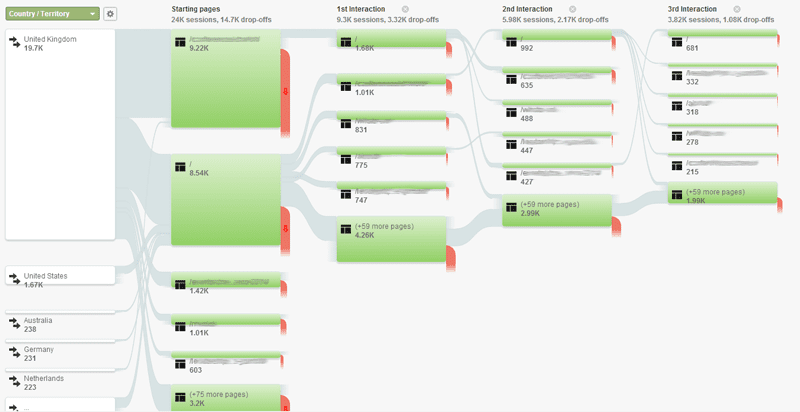 Visitor flow diagram – follow your customer’s journey
There’s so many factors to consider when you have a website built if you want to generate business from it. So many people are sold a website that looks good, but fails to generate leads simply because it’s not user-friendly or cannot be found in search engines. See our post on form following function in website design.
It can be something simple like your contact details are hard to find, or it’s not obvious how to do business with you. Do you hide your phone number because you’d rather people email? It may sound like a good idea, but you could be alienating a good portion of the population who prefer to pick up the phone, speak to a human and get answers to their questions straight away.
Perhaps your website is full of beautifully crafted copy, with a witty conversational tone. Sure, you’re creating a sense of personality for your brand, but have you actually told your website visitors what you do? And, of course, it’s not just website visitors who need to know what you do, it’s search engines as well. I’ve seen some amazing websites with some really outstanding copy, but not once have they mentioned their product or service, their keywords, the phrase people will likely type into the search box to find them.
If you want to get the best from your online marketing campaigns, you first need to assess how your website performs in converting traffic into leads and sales. If you already know you’re getting traffic, but not generating enquiries, there’s clearly something amiss and needs to be addressed before investing in a campaign to drive more traffic.
Get some help from a digital marketing expert!
This is where a digital marketing consultant can help, with advice on optimisation to ensure your website will get noticed by the search engines as well as usability to make sure your website visitors can successfully navigate your website, find the information they need and take the next step to becoming a customer.
A digital marketing expert will also look at your website copy and design to ensure it’s giving prospects the right impression of your company and the products and services you offer. A second pair of eyes can save you a lot of money in the long run, so don’t be afraid to ask for advice from someone impartial before parting with your marketing budget.
Leave a Reply